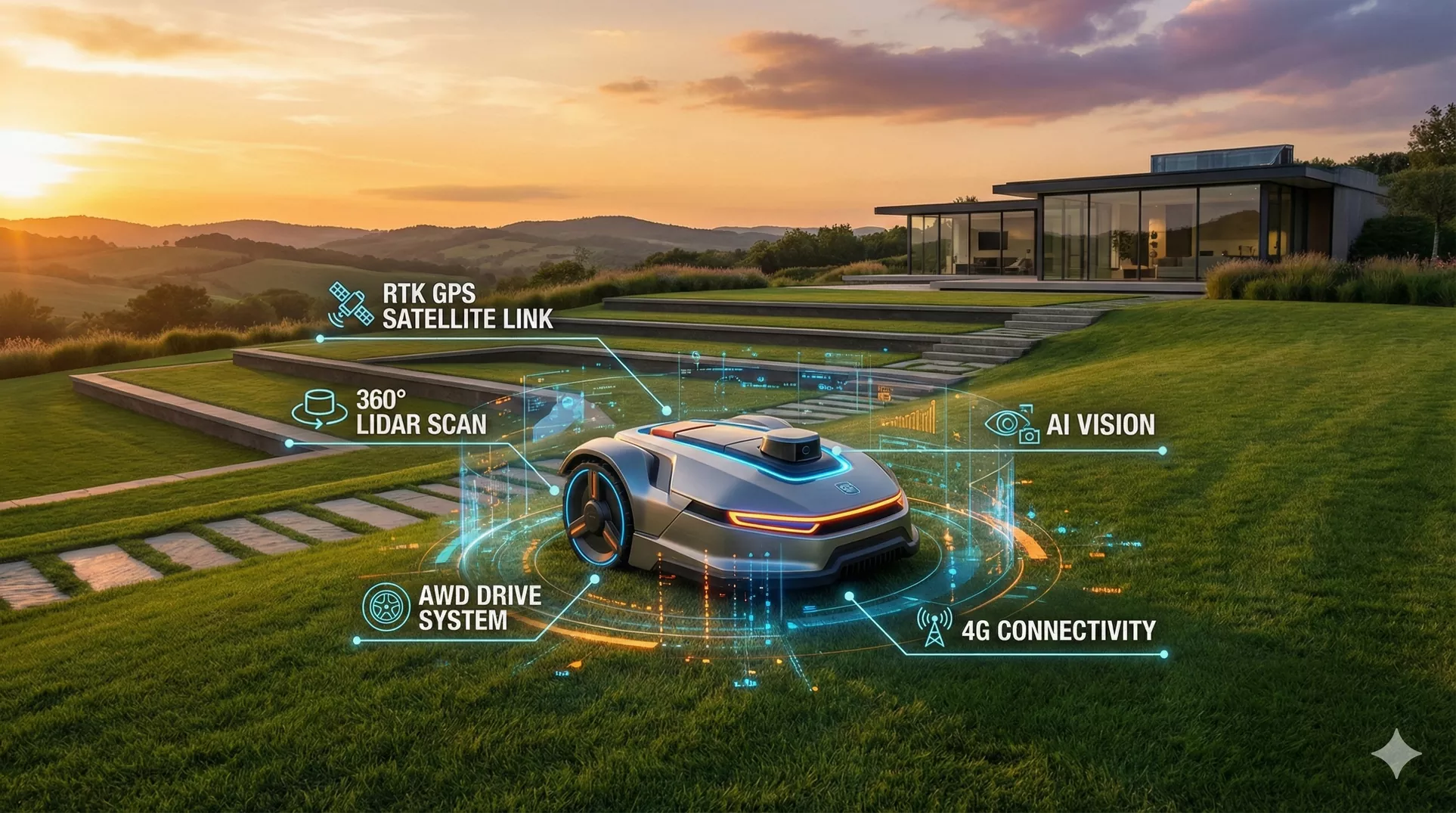
The era of the “dumb,” bumping robot mower is over. Gone are the days of burying perimeter wires, dealing with broken cables, and watching your robot bounce around like a drunk sheep.
In 2026, we have entered the age of Intelligence. We have robots that see with 360° AI Vision, navigate with LiDAR lasers, climb 84% slopes, and cut grass with the precision of a golf course groundskeeper.
But with new technology comes new confusion. What is the difference between RTK and VIO? Do you really need AWD? Is a 17-inch cutting deck worth the extra money?
At Robot Mower Lab, we have tested the best (and the worst). This guide will strip away the marketing jargon and explain the 7 critical specs you must understand before you drop $2,000 on a new machine.
Navigation: The “Brain” (RTK vs. Vision vs. LiDAR)
This is the single most important spec. If the robot gets lost, it stops working. In 2026, “Wire-Free” is the standard, but how they achieve it varies.
A. RTK-GPS (Real-Time Kinematic) This is the standard for most mid-range mowers. It uses satellites plus a reference station (antenna) in your yard to triangulate position.
- Pros: Accurate to the centimeter in open spaces.
- Cons: “GPS Drift.” Tall trees, big houses, or metal fences can block the signal. If you have heavy tree cover, pure RTK will fail.
B. AI Vision (VIO / EFLS) This is Segway’s secret weapon (seen in the Navimow i-Series and X4 Series).
- How it works: It uses cameras to “see” the edges of your lawn and recognize non-grass surfaces.
- Why it matters: It acts as a backup when GPS fails. If the robot goes under a tree, its eyes take over.
C. LiDAR (Laser Navigation) The new gold standard for complex yards, championed by the Mammotion Luba 3.
- How it works: It shoots laser pulses to map the 3D environment, just like a self-driving car.
- Why it matters: It works in total darkness and under the densest forests where cameras and GPS are blind.
Verdict:
- Open Sky: RTK is fine.
- Some Trees: Vision + RTK (Segway).
- Deep Forest: LiDAR (Mammotion).
Drive System: The “Legs” (FWD vs. RWD vs. AWD)
Your lawn is not a flat soccer field. The drive system determines if your robot gets stuck in a pothole or climbs a mountain.
- FWD (Front-Wheel Drive): Found in budget models. They struggle with traction and often get stuck when turning on slopes.
- RWD (Rear-Wheel Drive): The industry standard (e.g., Segway X3). Good for slopes up to 45% (24°).
- AWD (All-Wheel Drive): The “Off-Road Kings.” Found in the Luba Series and the new Segway X4. These use four powerful motors to conquer slopes of 80% (38°) or more.
Pro Tip: If your yard has a slope that makes you sweat when pushing a mower, you need an AWD robot.
Efficiency: Cutting Width & Battery
Don’t just look at the “Max Area” on the box. Look at the Cutting Width.
- Standard (18 cm / 7 in): Most entry-level mowers. They take forever to cut 0.5 acres.
- Wide (24 cm+ / 10 in+): Found in flagship models like the Segway X4.
- The Math: A 24cm deck cuts 33% more grass per pass than an 18cm deck. This means the robot finishes faster, charges less often, and leaves your lawn free for you to enjoy.
Battery Rule of Thumb: Always buy a mower rated for Double your actual lawn size. If you have 0.25 acres, buy a 0.5-acre model. Why? Because “Max Area” assumes the robot runs 24/7. You don’t want a robot living on your lawn; you want it to finish the job and hide.
Obstacle Avoidance: Bumping vs. Seeing
- Mechanical Bumper (The “Bonk”): The robot has to hit the tree to know it’s there. This damages the bark and scratches the robot.
- Ultrasonic Sensors: Sees big objects, but misses small toys.
- VisionFence / Camera AI: The robot identifies objects (“That’s a hose,” “That’s a dog”) and navigates around them without touching. This is essential if you have kids or pets.
Connectivity: Wi-Fi vs. 4G vs. Bluetooth
How do you talk to your robot?
- Bluetooth: Only works when you are standing next to it. Annoying.
- Wi-Fi: Great, but does your home Wi-Fi reach the bottom of your garden? Probably not.
- 4G / Cellular: The best option. It allows you to control the mower from the office and, more importantly, track it via GPS Anti-Theft if someone steals it. (Note: Luba 3 offers 3 years free; Segway typically offers 1 year).
Cutting Height: The “Grass Type” Factor
Not all grass is the same.
- Warm Season (Bermuda/Zoysia): Needs to be cut LOW (0.75 – 1.5 inches).
- Cool Season (Fescue/Kentucky Bluegrass): Needs to be cut HIGH (3.0 – 4.0 inches) to stay healthy in summer.
The Trap: Some mowers (like the older Luba 2) forced you to buy a specific “H” version for high cutting. The Solution: Look for “Universal” height adjustment. The Segway X4 covers the full range (0.75 – 4.0 inches) in one machine.
Support & Parts: The Hidden Risk
This is where many buyers get burned by “cheap” brands on Kickstarter or Amazon.
A robot mower has moving parts. Wheels wear out. Blades dull. Batteries degrade.
- Tier 1 Brands (Segway, Husqvarna, Mammotion): You can buy replacement blades, motors, and batteries easily.
- Budget Clones (Redkey, Kowoll, etc.): Once they break, they are e-waste. We wrote a detailed warning about this: Read our Redkey Warning here.
Summary: Which One Should You Buy?
Now that you understand the specs, here is our cheat sheet for 2026:
- The “Value King” for Small, Flat Yards:
- Pick: Segway Navimow i110N
- Why: Perfect for <0.25 acres, Vision AI included, very affordable.
- The “Tree Cover” Specialist for Complex Yards:
- Pick: Mammotion Luba 3 AWD
- Why: The 360° LiDAR is unbeatable for navigation reliability in bad signal areas.
- The “Efficiency Beast” for Large Estates:
- Pick: Segway Navimow X4 Series
- Why: Massive 17-inch cutting width, 84% slope handling, and universal cutting height.
Still have questions? Check out our Accessories Guide to see what upgrades you might need!
Thanks for this review. It helped me a little bit. I currently have the LUBA 2 (2024 – Not X) model. It has worked well for 2 full seasons. Its major weakness is when mowing taller grasses, i.e., 3.1″ Blue Grass. The front wheels are in line with the blades, and these push the grass down and the grass does not spring up fast enough for the blades to cut properly. This leaves a nasty tall line of grass around the perimeter. I alternate mowing patterns to marginalize this on the main body of grass. The other disappointing part is that it leaves 4″-5″ of uncut grass around walls and fences. That is a lot of string trimming every week. You did not mention any of this in your write up. Most of what you wrote can be obtained from their marketing websites. Hopefully, Lidar will allow these mowers to be more accurate against walls and fences so it can mow closer to objects. Also, Ecovacs A3000 Iidar pro now has a string trimmer built onto the mower to solve this problem.
Hi Chuck,
Thank you so much for taking the time to share your real-world, 2-season experience with the Luba 2.
First, I want to say I really appreciate the honest feedback. You make a completely fair point. Because this specific article was designed as a high-level “Buying Guide” to help beginners understand the different specs and navigation technologies, it didn’t dive deep enough into the physical, day-to-day realities of living with these machines. You are 100% right—what happens under the wheels and at the extreme edges is where the real test is.
Your observation about the inline wheels flattening 3.1″ Bluegrass is spot on. Because these AWD machines are quite heavy (often 40+ lbs), they act almost like a mini steamroller on cool-season grasses. By the time the grass tries to spring back up, the cutting deck has already passed over it. Setting the app to alternate the mowing angle (checkerboard pattern) is exactly the right workaround for the main yard, but as you mentioned, it doesn’t solve the perimeter passes.
Regarding the 4″-5″ uncut gap along walls and fences: this is truly the “dirty little secret” of the RTK robot mower industry. Because of safety regulations and physical bumper designs, the spinning blades are housed several inches inside the outer shell. No matter how accurate the GPS is, physical physics prevents a true zero-edge cut against a solid wall.
I completely agree with your outlook on the future. The shift toward 360° LiDAR (like we are seeing on the Luba 3) is helping machines navigate right up to the edge with much more confidence. And you are spot on about the hardware innovations—solving that last 4 inches of string trimming is the next great frontier. We are finally seeing brands experiment with offset cutting decks and built-in edge trimmers (like the models from Ecovacs, Dreame, and the Yuka) to address this exact headache.
Thanks again for holding us to a high standard, Chuck. Your insight is incredibly valuable to anyone reading this guide who is trying to figure out what owning a robot mower is actually like!
Best regards,
Robot Mower Lab