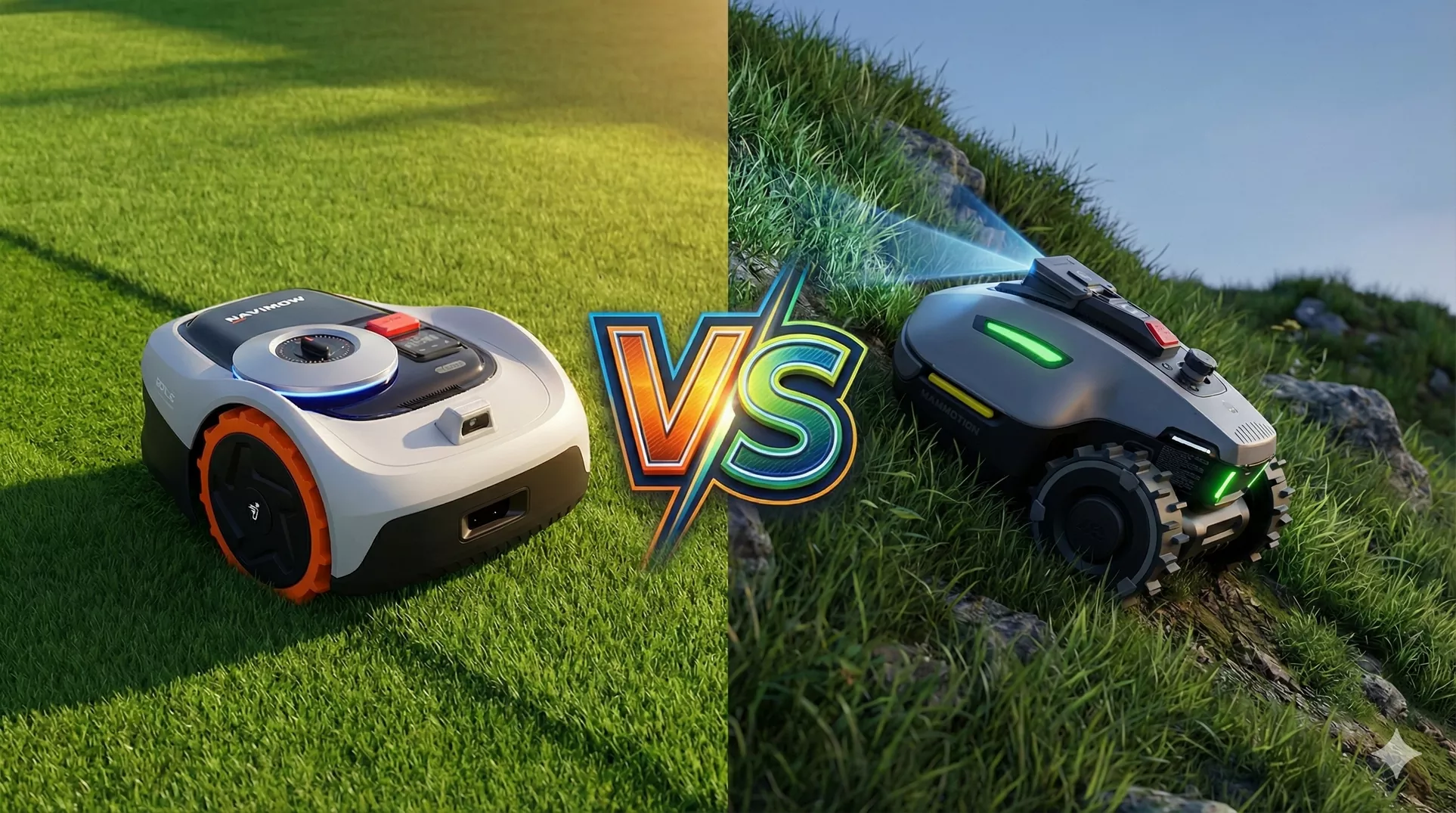
For years, the “wire-free” robot mower dream was locked behind a $2,500 paywall. Then came 2024, and the game changed forever.
Today, we are witnessing the battle for the sub-$1,000 lawn. In one corner, we have the Segway Navimow i105N, the polished, user-friendly champion that brought RTK technology to the masses. In the other corner stands the Mammotion YUKA Mini 700H (often referred to as the YUKA 600 or Mini series in different regions), an aggressive challenger packing “Pro” features—like 3D vision and slope handling—into a compact, budget-friendly body.
Both robots promise to free you from perimeter wires. Both use cameras to see your yard. But after analyzing the specs and performance, it’s clear they are built for two very different types of owners.
At a Glance: The Specs War
| Feature | Segway Navimow i105N | Mammotion YUKA Mini 700H |
|---|---|---|
| Max Coverage | 0.12 Acre (500m²)Software Locked | 0.17 Acre (700m²) 🏆~40% More Area |
| Slope Handling | 30% (approx. 16°)Flat Lawns Only | 50% (approx. 27°) 🏆Climbs Steep Hills |
| Cutting Deck | Fixed Single DiscRisk of scalping on bumps | Floating Single Disc 🏆Adapts to uneven ground |
| Navigation | VisionFence + RTK 🏆More stable app & mapping | UltraSense 3D + RTKBetter obstacle recognition |
| Cut Height | 2.0 – 3.6 inchesManual Adjustment | 2.0 – 3.5 inchesManual Adjustment |
| Est. Price | ~$699 – $999 | ~$749 – $849 🏆Better Value |
Round 1: Navigation & Intelligence (The “Eyes”)
The biggest fear with wire-free mowers is signal loss. Both brands solve this, but they do it differently.
Segway Navimow i105N:
Segway uses a system called VisionFence. It combines satellite (RTK) data with a 140° wide-angle camera. If the satellite signal is blocked by trees, the camera takes over to navigate visually.
- The Pro: It is incredibly stable. The “Assist Mapping” feature is a game-changer—the robot literally identifies the edge of your grass and drives itself to create the map. It’s the easiest setup experience on the market.
- The Con: It can be too cautious, sometimes avoiding tall weeds as if they were obstacles.
Mammotion YUKA Mini 700H:
Mammotion takes a “brute force” approach with its UltraSense system, using Dual 3D Vision cameras plus RTK.
- The Pro: Because it uses two cameras (like human eyes), it has better depth perception than the Segway. It can theoretically navigate more complex, cluttered yards with tighter spaces.
- The Con: The mapping process is more manual compared to Segway’s AI automation.
Winner: Segway for ease of use; Mammotion for complex environments.
Round 2: The Cut (Fixed vs. Floating Deck)
This is the most critical hardware difference that most reviews miss.
Segway i105N (The Fixed Deck):
The cutting disc on the Segway is fixed to the chassis. It does not move up and down.
- The Problem: If your lawn has small dips, divots, or bumps, the robot might “scalp” the ground (shave the dirt) or get high-centered. It requires a relatively smooth lawn to perform perfectly.
Mammotion YUKA Mini (The Floating Deck):
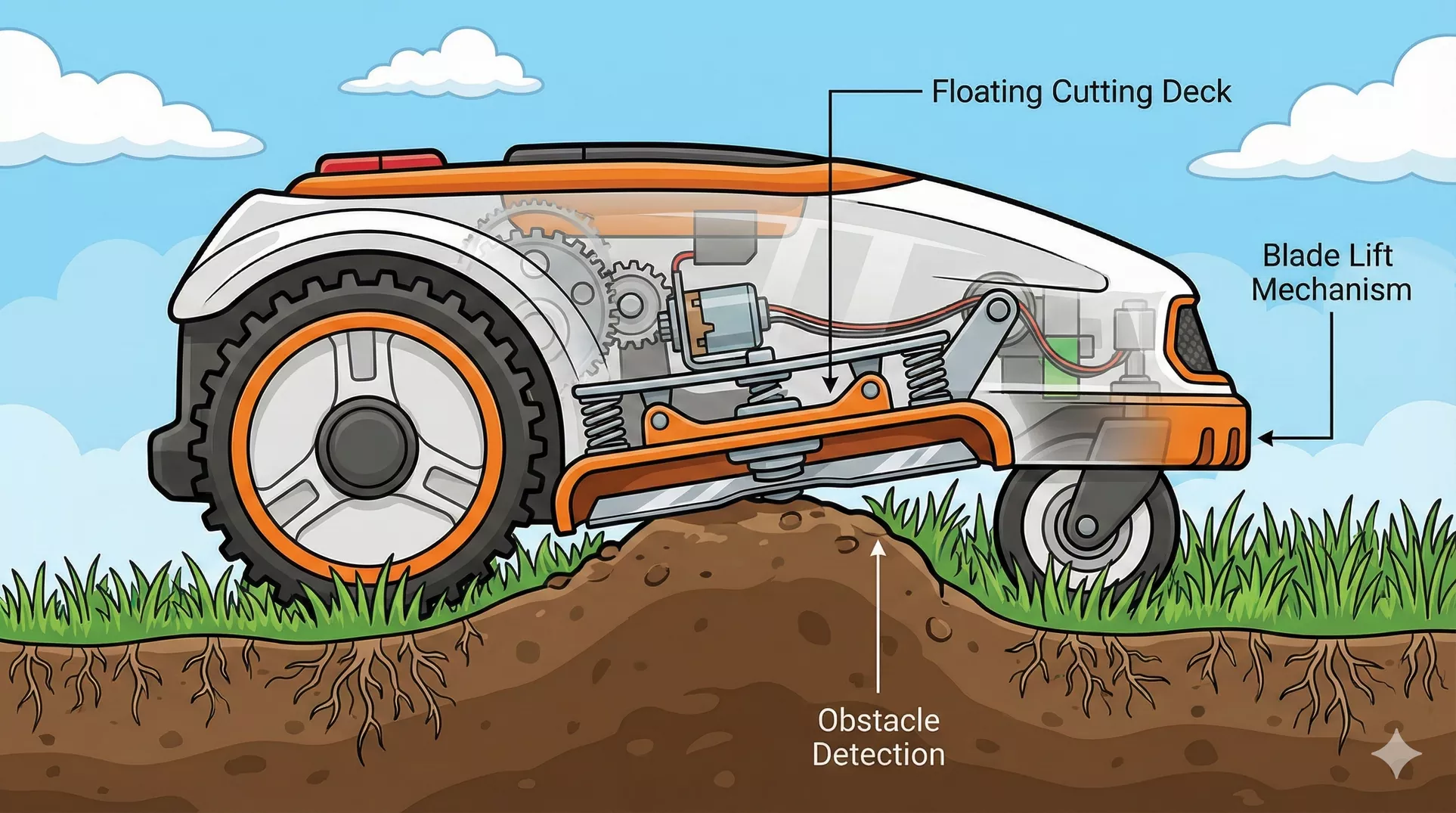
The YUKA borrows the floating deck design from the expensive Luba series. The cutting disc is suspended on a spring-loaded mechanism.
- The Advantage: If the robot drives over a bump, the blade deck floats up to avoid hitting the dirt. If it hits a dip, it lowers to maintain an even cut.
- The Result: A much more consistent, “carpet-like” finish on uneven ground.
Winner: Mammotion YUKA. It’s simply better hardware for real-world (imperfect) lawns.
Round 3: Terrain & Slopes
Do you have hills? This section decides your purchase.
- Segway i105N: Rated for 30% slopes (16°). It is a front-wheel-drive machine. On wet grass or steep inclines, it can struggle to find traction and may slide out of bounds.
- Mammotion YUKA: Rated for 45% slopes (24°). The design is more rugged, and the weight distribution allows it to climb significantly steeper hills than the Segway.
Winner: Mammotion YUKA. It handles hills that would trigger a “Wheel Slip” error on the Segway.
The “Dealbreaker”: Software vs. Hardware
Here is the uncomfortable truth you need to know before buying.
Segway is a software company first. The Navimow App is polished, virtually bug-free, and receives constant, meaningful updates. The customer support is generally responsive and established. It feels like an Apple product—it just works.
Mammotion is a hardware company first. They give you incredible specs for the money (Floating deck! 3D Vision! 45% slope!), but their app can feel like a “beta” version. Users often report occasional bugs with firmware updates, and customer support can be slower to respond than Segway’s.
Final Verdict: Which One Should You Buy?
These are both incredible machines that put older brands like Husqvarna to shame. However, the choice comes down to your lawn’s topography and your patience level.
Buy the Segway Navimow i105N if:
- Your lawn is flat. (This is non-negotiable).
- Your total grass area is strictly under 0.12 acres (500m²).
- You want a “set it and forget it” experience with zero tinkering.
- You value a polished app and reliable software over raw power.
Buy the Mammotion YUKA Mini 700H if:
- Your lawn is bumpy, rutted, or has slopes up to 24°.
- You need slightly more coverage (up to 0.17 acres).
- You want the best possible cut quality thanks to the floating deck.
- You are tech-savvy and don’t mind occasional app quirks in exchange for superior hardware performance.